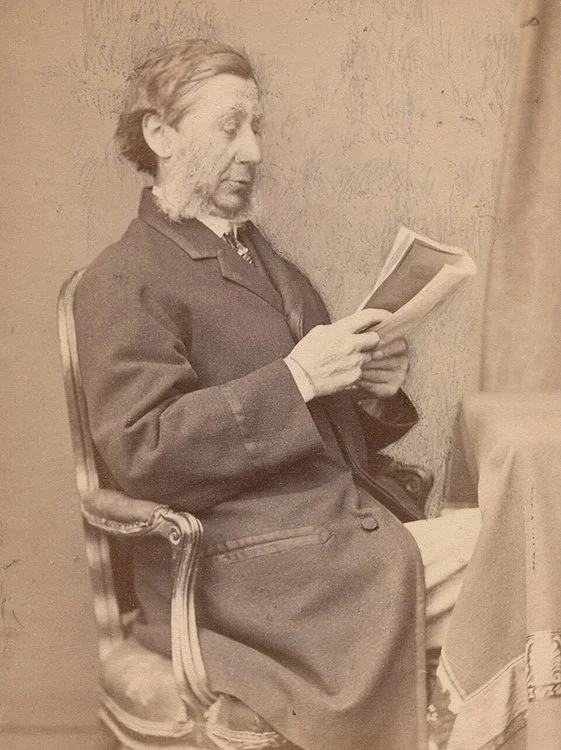
Henry Jutsum
Oil and Watercolor: a Life in Landscape Painting
John Watkins, Portrait of Henry Jutsum, ca. 1860. Albumen silver print. Metropolitan Museum of Art (1970.659.464).
Henry Jutsum (11 September 1816 – 3 March 1869) was a British landscape painter who worked in oils and watercolors. A pupil of James Stark of the Norwich School of painters, Jutsum was known for his naturalistic depictions of the British countryside.
Jutsum exhibited extensively at the Royal Academy, the British Institution, and other London exhibitions. He was a member of the New Society of Painters in Water Colours (now the Royal Institute of Painters in Water Colours) from 1843 to 1848 before returning his focus to oil painting. His work was praised by contemporary critics for its close observation of nature and poetic qualities, and is represented in a number of British public collections.
Early Life and Education
Henry Jutsum was born in London on 11 September 1816, the son of John and Elizabeth Jutsum.⁽¹⁾ His father died when he was three, leaving behind a will that established a trust for the upbringing and education of Henry and his older brother Rowland.⁽²⁾ John Jutsum had been a cheesemonger, and his wife Elizabeth appears to have continued the family business.⁽³⁾
Jutsum received at least a portion of his education in Devonshire. He showed an early interest in drawing, reportedly making frequent studies in Kensington Gardens. He later studied landscape painting under James Stark, becoming his pupil in 1839.⁽⁴⁾ Stark, a prominent member of the Norwich School of painters, was known for his naturalistic landscapes and his practice of painting outdoors.⁽⁵⁾ Like Stark, Jutsum developed a naturalistic approach to landscape painting, combining close observation of the natural world with a focus on the changing effects of light and atmosphere.⁽⁶⁾
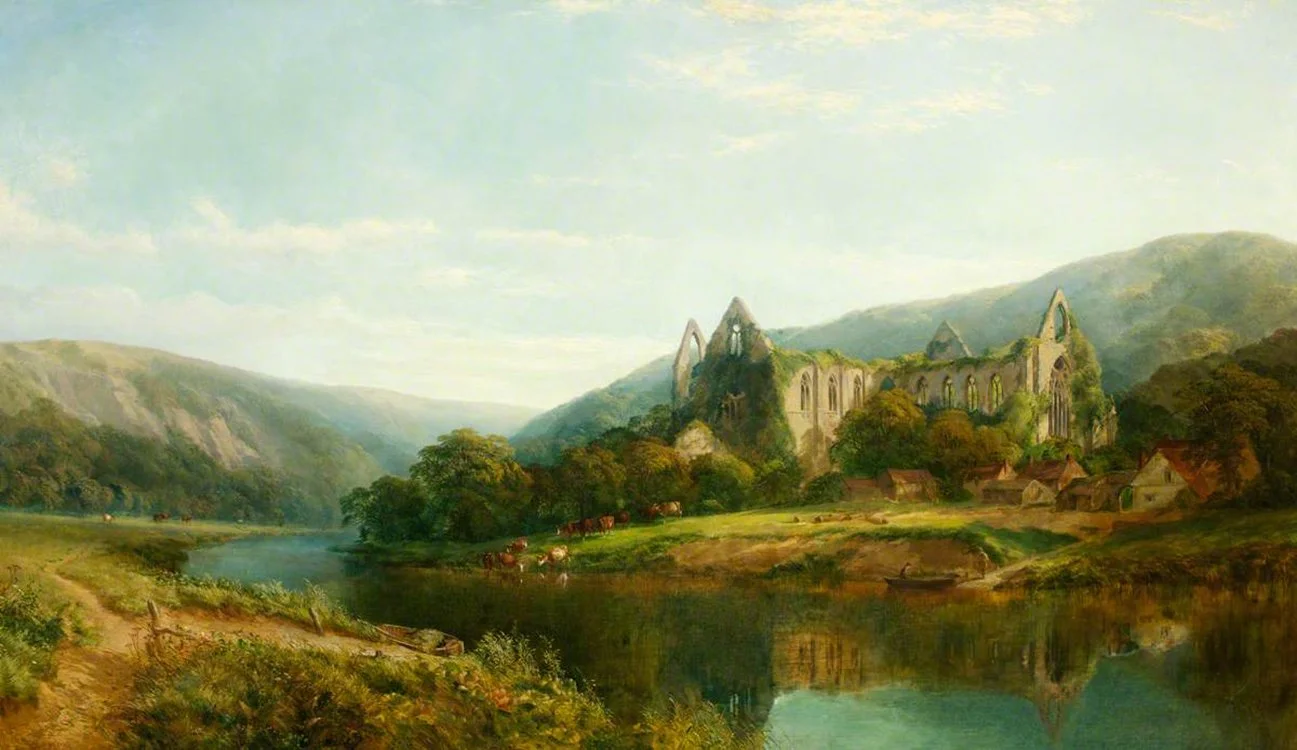
Tintern Abbey, undated. Oil on canvas, 27.3 × 47 in. Newport Museum and Art Gallery (NPTMG:1953.89).
Career
In 1836, Jutsum began exhibiting at the Royal Academy. His early work included both oil paintings and watercolors.⁽⁷⁾
In 1843, Jutsum became a member of the New Society of Painters in Water Colours (now the Royal Institute of Painters in Water Colours). Its members included fellow landscape painters Henry Bright and David Cox Jr., as well as the prominent watercolorist and lithographer Louis Haghe.⁽⁸⁾ Jutsum concentrated primarily on watercolor painting during his membership, exhibiting regularly before resigning in 1848 to devote greater attention to painting in oils.⁽⁹⁾ Jutsum's membership coincided with a period of growing public appreciation for watercolor painting in Britain, as increasingly ambitious exhibition works and dedicated artists' societies helped establish the medium as an independent form of fine art.⁽¹⁰⁾
Some of Jutsum's notable paintings included Coldingham, on the Berwickshire Coast (1853), A Highland Village, Evening (1854), and Flitting Shadows (1855).⁽¹¹⁾ The latter, exhibited at the Royal Academy, attracted the attention of the critic John Ruskin, who discussed the painting in his Academy Notes of 1855. Ruskin's assessment combined praise with reservations about aspects of its execution.⁽¹²⁾
In 1858, The Art Journal published an engraving by Robert Brandard after Jutsum's small painting The Noon-Day Walk, accompanied by an appreciation of his work. The article praised Jutsum's observation of nature and the poetic qualities of his landscapes, while noting that the small painting, executed in 1845, was not fully representative of his more mature abilities.⁽¹³⁾
Jutsum was a frequent contributor to London's principal art exhibitions, and his works were described by later biographers as widely admired.⁽¹⁴⁾ Over his career, Jutsum exhibited many works, including 68 paintings at the Royal Academy, 75 at the British Institution, and 19 at the Society of British Artists' Suffolk Street exhibitions.⁽¹⁵⁾
Jutsum remained active as a painter until his death in London on 3 March 1869, aged 52.⁽¹⁶⁾
Artistic Style and Technique
Specializing in landscape painting, Jutsum worked in both oils and watercolors. His subjects included wooded countryside, rivers, coastal villages, and mountainous scenery, frequently incorporating rustic buildings and figures. He depicted scenes throughout England, Scotland, and Wales, including subjects in Devonshire, Yorkshire, and the Scottish Highlands.⁽¹⁷⁾ Contemporary critics recognized both the observational and poetic qualities of his work.⁽¹⁸⁾
Jutsum practiced painting and sketching directly from nature.⁽¹⁹⁾ Art historian Janet Whitmore has characterized Jutsum's mature landscapes by their careful botanical accuracy and scientifically precise cloud formations, qualities evident in both his oil paintings and watercolors.⁽²⁰⁾ His work also reflected an interest in capturing transient effects of light and atmosphere.⁽²¹⁾
In 1854, Jutsum wrote of spending nearly three weeks with the artist John Middleton, while also describing his observations of natural forms and the effects of changing light:⁽²²⁾
…what difficulties beset the poor painter in the slow progress his means afford of rendering on canvas the intricate markings of the bark of an old old oak or the graceful interlacing of masses of Fern or Brake — more particularly with the great change of light in one spot during a day's sunlight…
The correspondence also provides insight into his working methods, including his use of chrome yellow and emerald green, two relatively new synthetic pigments that had expanded the range of colors available to nineteenth-century landscape painters.⁽²³⁾
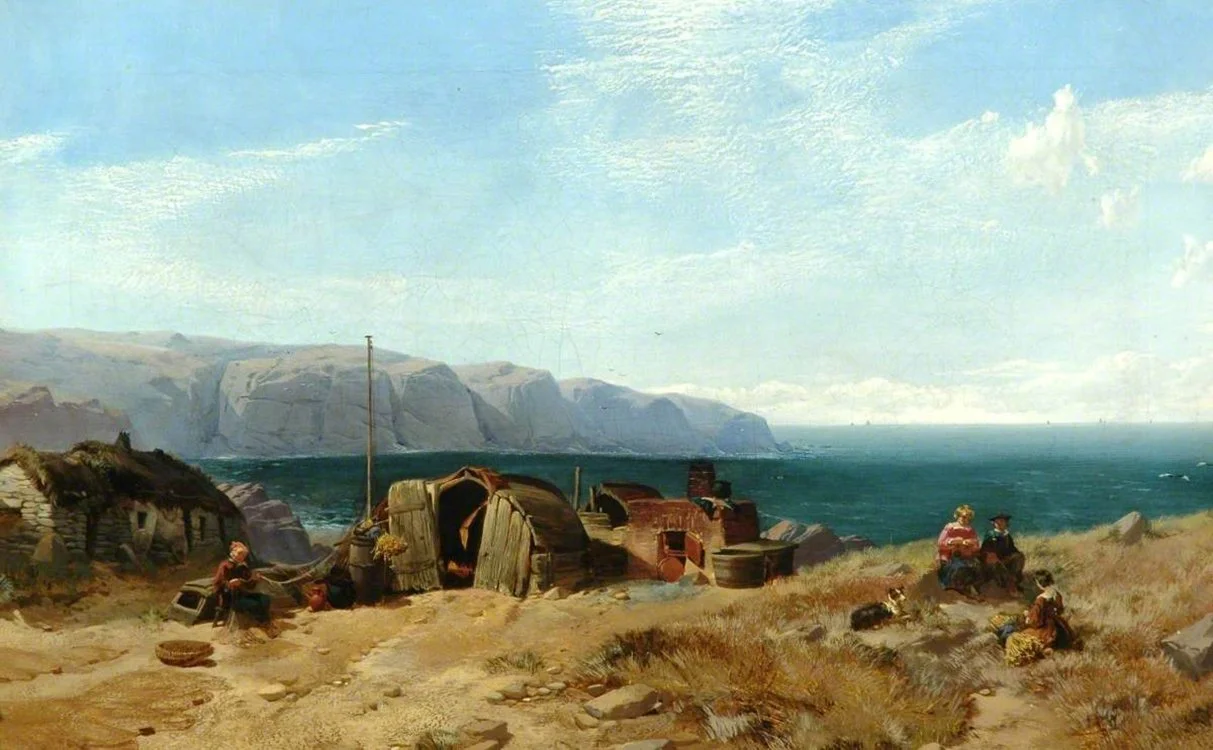
Arran, undated. Oil on canvas. Bradford Museums and Galleries (1931-021).
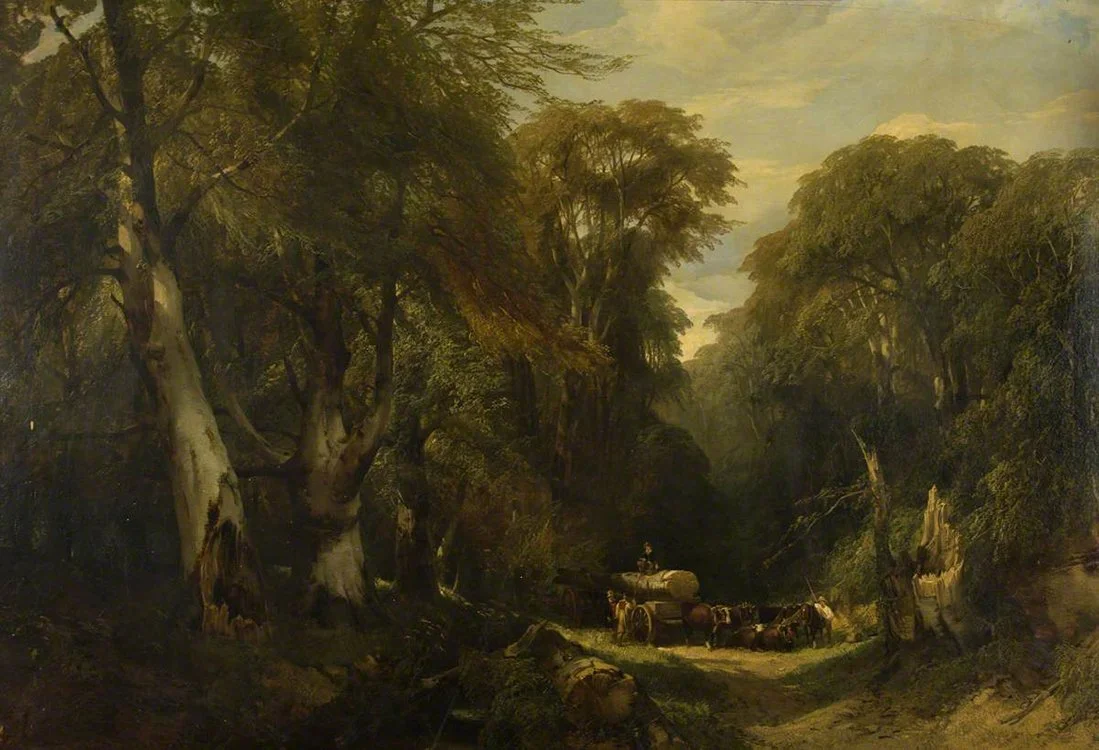
The New Forest, undated. Oil on canvas. Perth Art Gallery (1-113A).
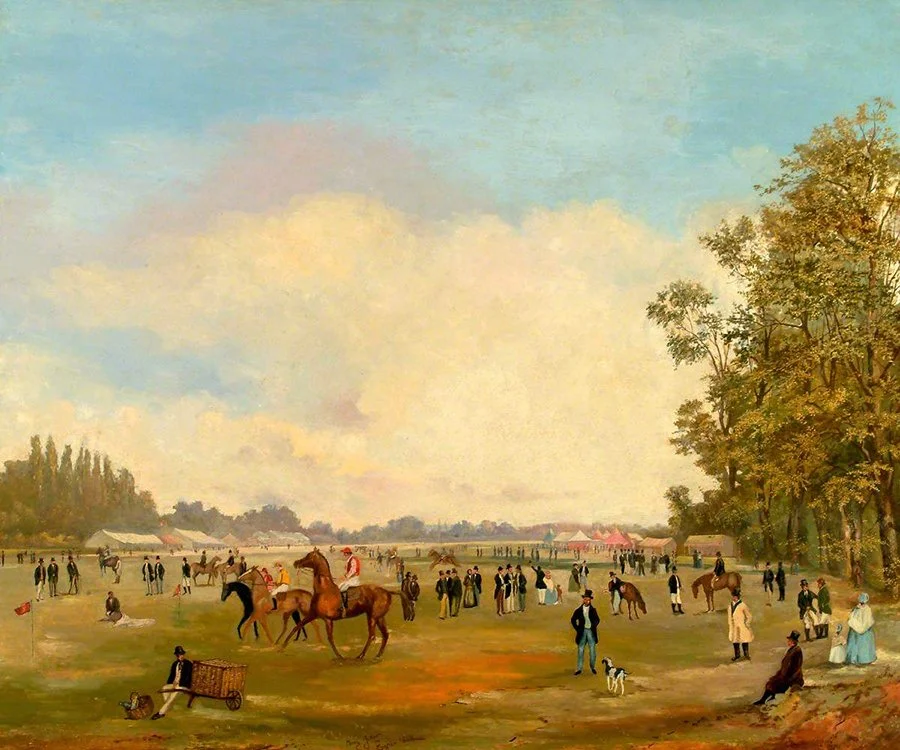
Egham Races, undated. Oil on canvas. Chertsey Museum (Oa.164).
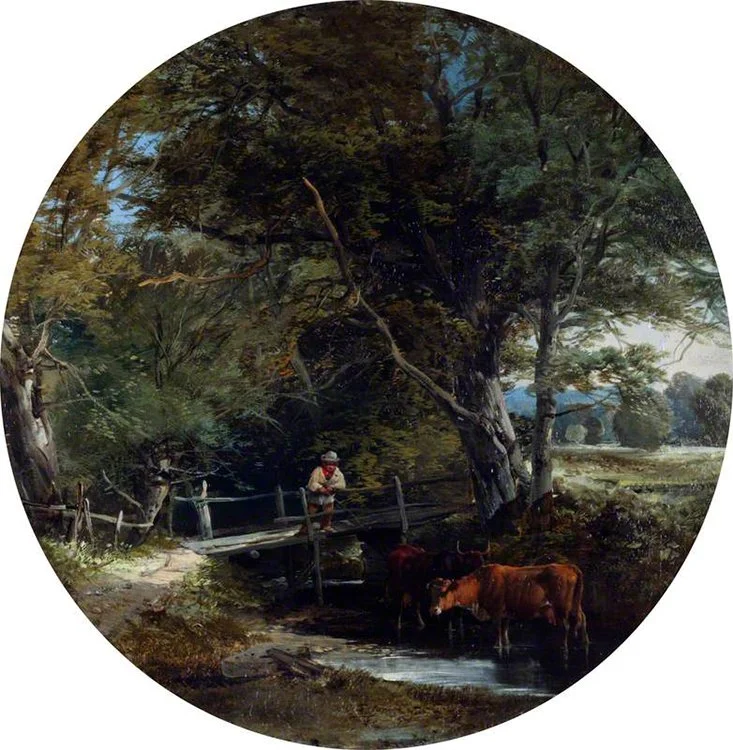
The Foot Bridge, undated. Oil on canvas. Victoria and Albert Museum (1419-1869).
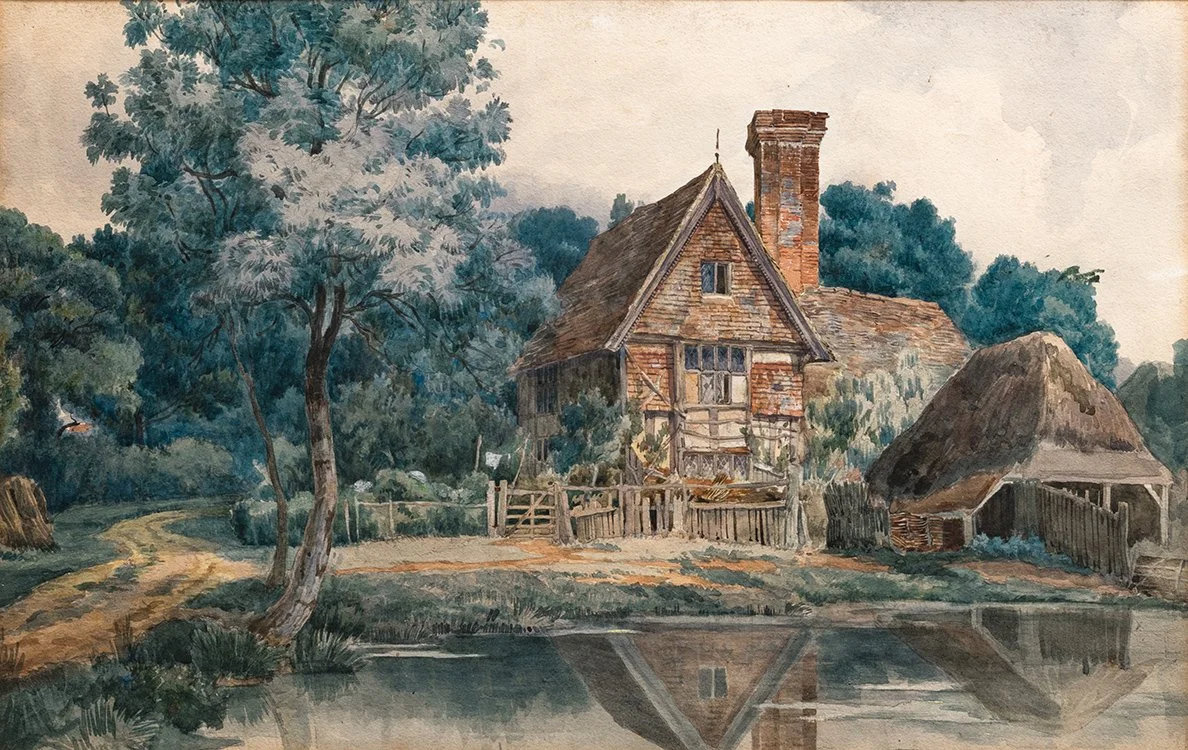
Old Farmhouse Beside a Pond, ca. 1843—1848. Watercolor on wove paper, 10 x 15 in. Private collection.
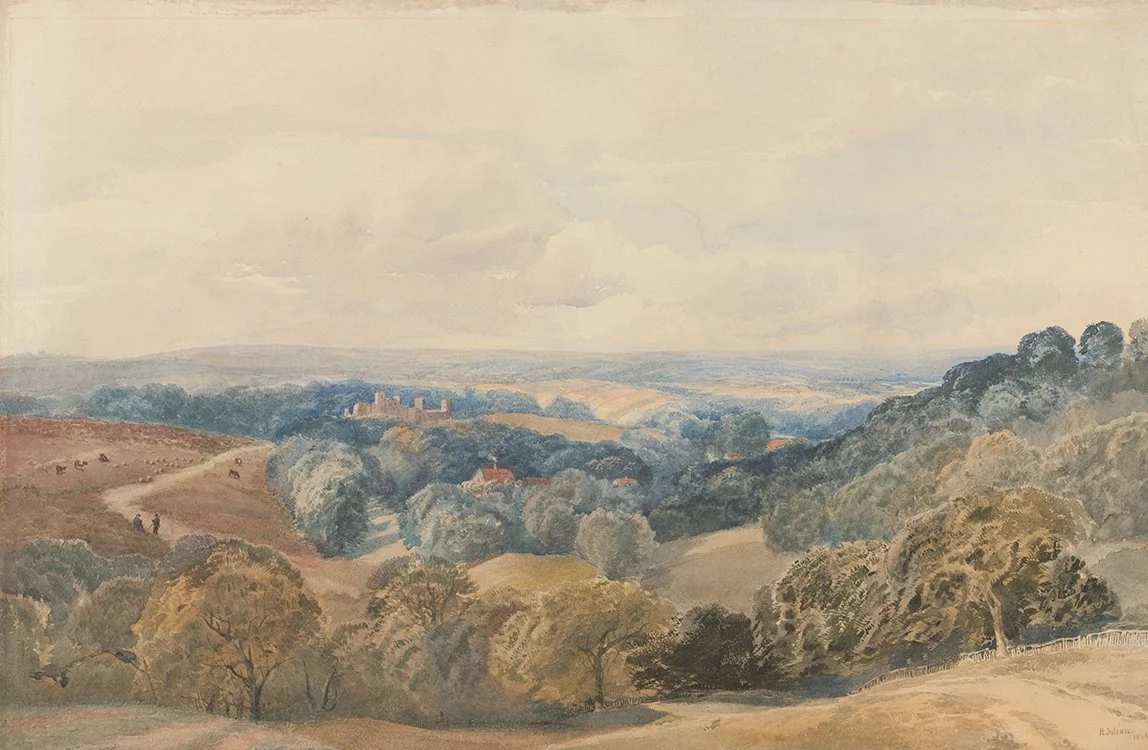
Landscape with Crieff Castle, 1865. Watercolor on paper, 15.6 × 23.6 in. Rijksmuseum (RP-T-1986-58).
Personal Life
Jutsum maintained his home in London throughout his adult life, residing at various addresses before settling in St John's Wood.⁽²⁴⁾ He shared a household with his older brother Rowland, together with domestic servants, including Mary A. Eggleton, who remained in the household for many years.⁽²⁵⁾ Census records show no evidence that Jutsum ever married.⁽²⁶⁾ Upon his death in 1869, administration of his estate was granted to Rowland, his brother and only next of kin.⁽²⁷⁾
Legacy
Within a year of his death in 1869, Jutsum's remaining studio works were offered for sale at Christie's.⁽²⁸⁾ A further sale associated with his collection was recorded in 1882.⁽²⁹⁾
Jutsum's contribution to nineteenth-century British landscape painting is reflected in his extensive exhibition record and the survival of his works in public and private collections. His paintings are represented in several British public collections, including the Victoria and Albert Museum, Birmingham Museums Trust, Newport Museum and Art Gallery, and the Government Art Collection.⁽³⁰⁾
Jutsum's career was documented in contemporary and later biographical reference works, including Samuel Redgrave's A Dictionary of Artists of the English School (1874) and The Dictionary of National Biography (1892).⁽³¹⁾
Researched and written by Blake Manning, 2026.
Notes
1. St Marylebone, London, baptismal register, 4 October 1816, Henry Jutsum, son of John and Elizabeth Jutsum.
2. Will of John Jutsum, cheesemonger of Princes Street, Cavendish Square, Middlesex; proved 3 February 1820. The National Archives, PROB 11/1625.
3. "London Street Directory in 1843 – J7". London Wiki. Retrieved 20 October 2026. London Wiki
4. Cust, Lionel (1892). "Jutsum, Henry" . In Lee, Sidney (ed.). Dictionary of National Biography. Vol. 30. London: Smith, Elder & Co. DNB
5. Landscape with a donkey. National Gallery of Victoria. Retrieved 20 October 2026.; "James Stark (1794–1859), On the Yare: a wooded river landscape with cattle, a figure and a cottage". Christie's. Retrieved 20 October 2026. NGV · Christie’s
6. Whitmore, Janet. "Henry Jutsum". Rehs Galleries. Retrieved 20 October 2026. Rehs Galleries
7. "Jutsum, Henry". Suffolk Artists. Retrieved 20 October 2026. Suffolk Artists
8. The Royal Institute of Painters in Water Colours (PDF). Chronological list of members and associates. Institute catalogue (PDF)
9. Whitmore, “Henry Jutsum.” Rehs Galleries
10. "History". Royal Institute of Painters in Water Colours. Retrieved 20 October 2026.; "Watercolor Painting in Britain, 1750–1850". The Metropolitan Museum of Art. Retrieved 20 October 2026. Royal Institute · Metropolitan Museum
11. “Jutsum, Henry,” Suffolk Artists. Suffolk Artists
12. Ruskin, John (1855). Academy Notes, 1855 (PDF). No. 121, Flitting Shadows. Ruskin (PDF)
13. “The Noon-Day Walk". The Art Journal: 92. 1858.
14. Cust, “Jutsum, Henry.” DNB
15. Boase, Frederic (1897). Modern English Biography. Vol. 2. Netherton and Worth. Entry for Henry Jutsum.
16. Cust, “Jutsum, Henry.” DNB
17. Whitmore, “Henry Jutsum.”; “Jutsum, Henry,” Suffolk Artists. Rehs Galleries · Suffolk Artists
18. “The Noon-Day Walk,” 92.
19. Henry Jutsum, illustrated manuscript letter, 4 August 1854 (date to be confirmed), Getty Research Institute, accession 860525, box 4, folder 36.
20. Whitmore, “Henry Jutsum.” Rehs Galleries
21. Jutsum, illustrated manuscript letter, Getty Research Institute, accession 860525, box 4, folder 36.
22. Jutsum, illustrated manuscript letter, Getty Research Institute, accession 860525, box 4, folder 36.
23. Jutsum, illustrated manuscript letter, Getty Research Institute, accession 860525, box 4, folder 36.; "Modern Pigments Found in Thomas Cole's Paintings Shed New Light on the Artist's Practice". The Metropolitan Museum of Art.; Historical Painting Techniques, Materials, and Studio Practice (PDF). Getty Conservation Institute. Metropolitan Museum · Getty (PDF)
24. England and Wales, National Probate Calendar (Index of Wills and Administrations), 1869, entry for Henry Jutsum; formerly of 174 Edgware Road, late of 88 Hamilton Terrace, St John's Wood.
25. 1851 England Census, household of Henry and Rowland Jutsum, including Mary A. Eggleton. [Add census piece, folio, and page.]; 1881 England Census, household of Rowland Jutsum, 88 Hamilton Terrace, St John's Wood, including Mary A. Eggleton. [Add census piece, folio, and page.]
26. England and Wales, National Probate Calendar (Index of Wills and Administrations), 1869, entry for Henry Jutsum; formerly of 174 Edgware Road, late of 88 Hamilton Terrace, St John's Wood.; 1881 England Census, household of Rowland Jutsum, 88 Hamilton Terrace, St John's Wood, including Mary A. Eggleton. [Add census piece, folio, and page.]
27. England and Wales, National Probate Calendar (Index of Wills and Administrations), 1869, entry for Henry Jutsum; formerly of 174 Edgware Road, late of 88 Hamilton Terrace, St John's Wood.
28. “Jutsum, Henry,” Suffolk Artists. Suffolk Artists
29. Cust, “Jutsum, Henry.” DNB
30. The National Gallery of British Art, Victoria and Albert Museum (PDF). Entry for Henry Jutsum, The Foot Bridge; Wooded Landscape with Sheep Crossing a Bridge. Birmingham Museums Trust. Retrieved 20 October 2026.; Tintern Abbey. Wikimedia Commons. Henry Jutsum, accession NPTMG-1953.89. Retrieved 20 October 2026.; "Landscape: Country Lane with a Cottage". Government Art Collection. Retrieved 20 October 2026. V&A catalogue (PDF) · Birmingham Museums · Tintern Abbey · Government Art Collection
31. Redgrave, Samuel (1874). A Dictionary of Artists of the English School. Longmans, Green and Co.; Cust, “Jutsum, Henry.” Redgrave · DNB