Enrique Rumoroso y Valdés
A Painter in the Age of Photography
Enrique Rumoroso y Valdés (ca. 1843–1897) was a Spanish painter whose career extended from scenes of everyday life to portraits of royalty and the aristocracy. His subjects included Andalusian fairs and dances, bullfighting themes, landscapes, portraits, and still life.⁽¹⁾
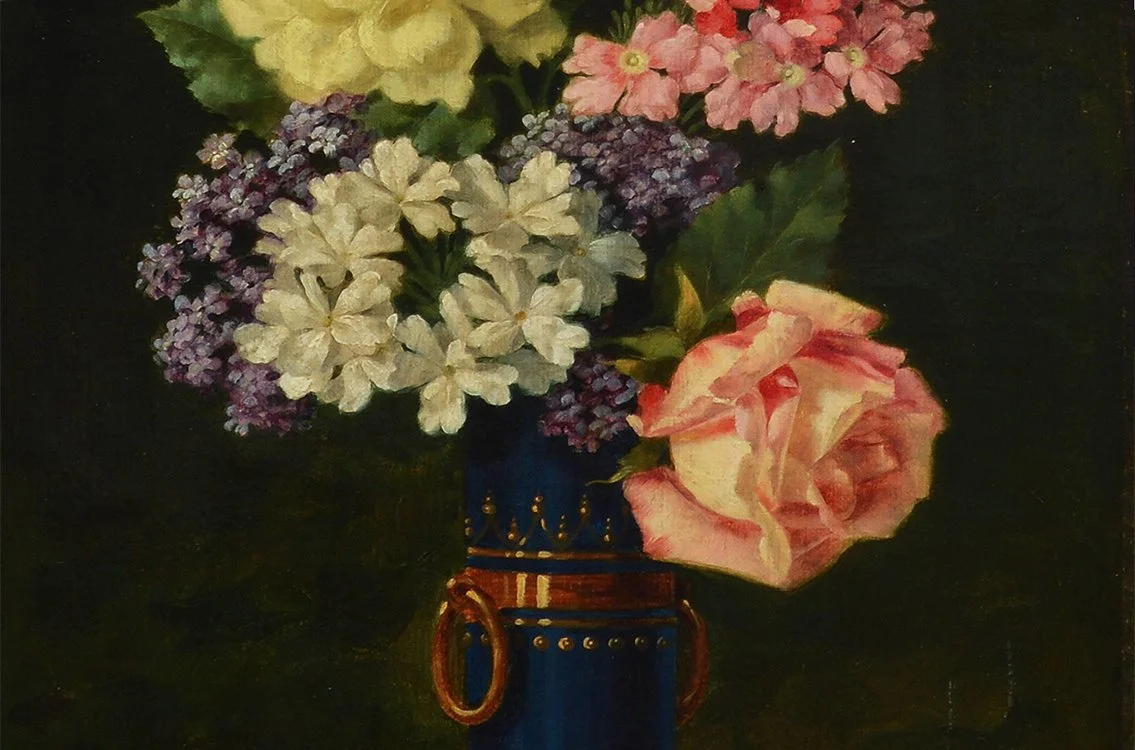
Still Life with Flowers (detail), ca. 1880–1895. Oil on canvas, 19.5 × 10 in. Private collection.
Born in Cádiz,⁽²⁾ Rumoroso became associated with Seville’s artistic community. He was a founding member of Seville’s Free Academy of Fine Arts, participating in its exhibitions during the 1870s and early 1880s.⁽³⁾ His works also appeared in exhibitions in Madrid and Paris. In 1879, A Tavern Scene earned him a bronze medal at the Cádiz Exhibition,⁽⁴⁾ and he later received an unspecified award at an exhibition in Paris.⁽⁵⁾
Among his portrait subjects were the Count and Countess of San Bernardo, the Countess of Guaqui, and members of the Spanish royal family.⁽⁶⁾
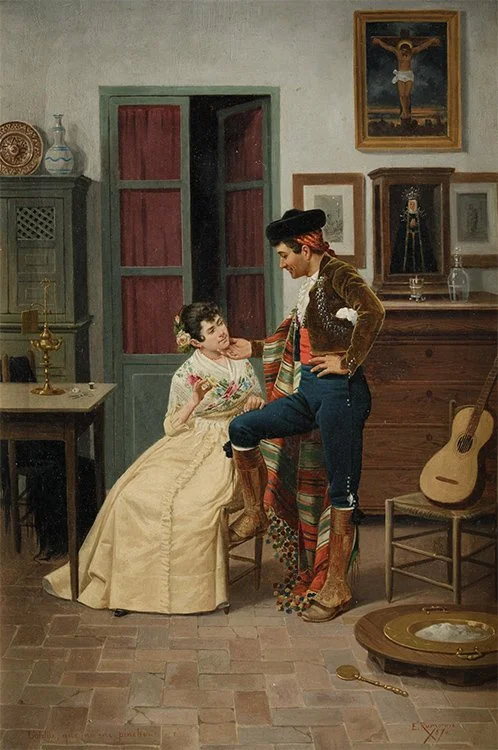
Lolilla, Don't Prick Me, 1890. Oil on canvas, 21.6 x 14.6 in. Private collection.
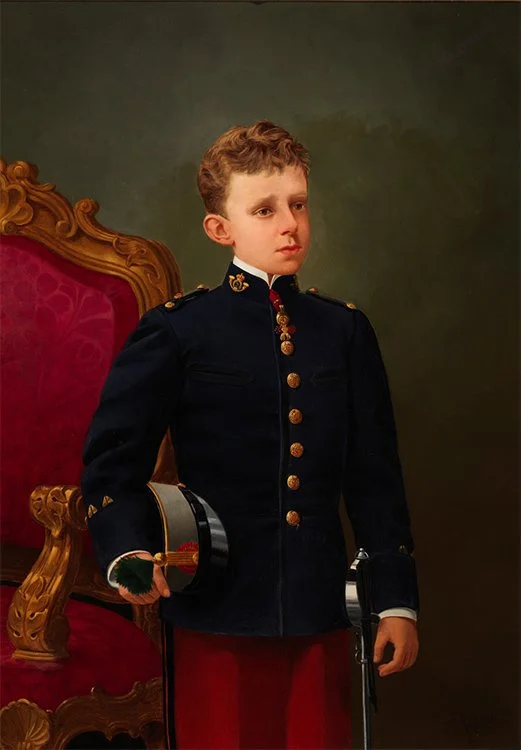
Alfonso XIII of Spain, ca. 1893. Oil on canvas, 41.3 × 29.5 in. National Museum of Prado.
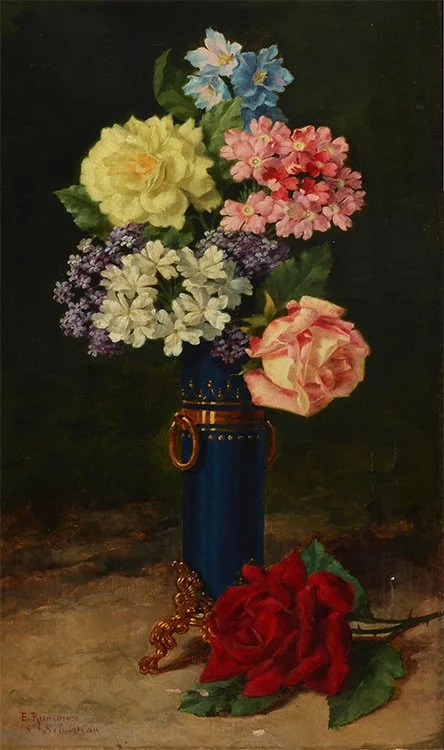
Still Life with Flowers, ca. 1880–1895. Oil on canvas, 19.5 × 10 in. Private collection.
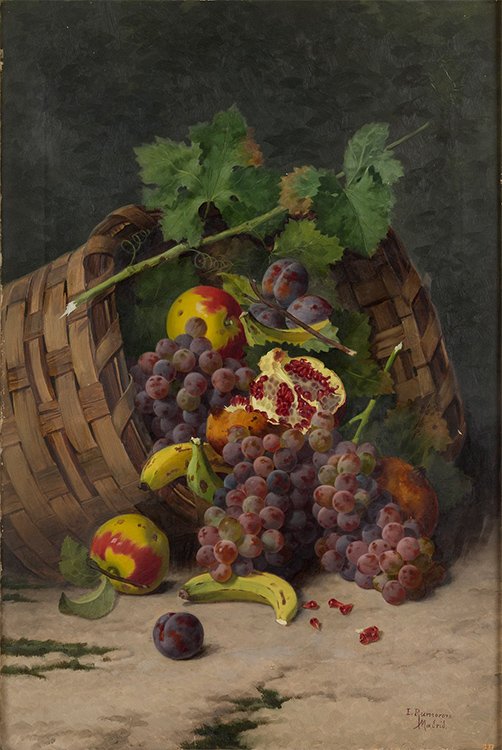
Still Life with Grapes. Oil on canvas, 33.4 × 22 in. Private collection.
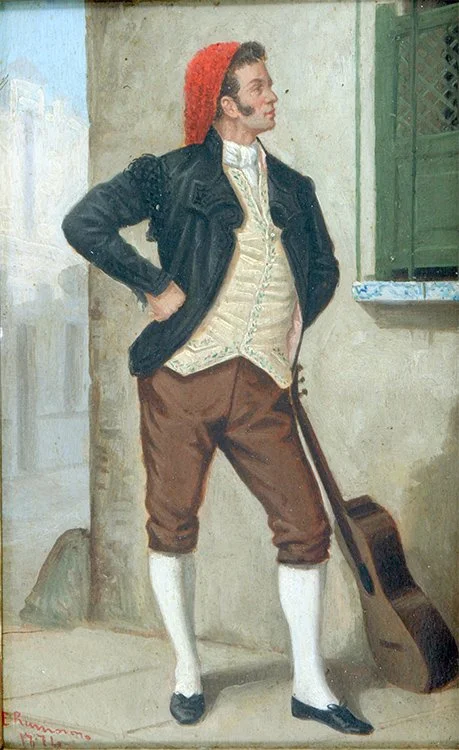
Spanish Man with Guitar, 1874. Oil on panel, 6.7 × 4.4 in. Private collection.
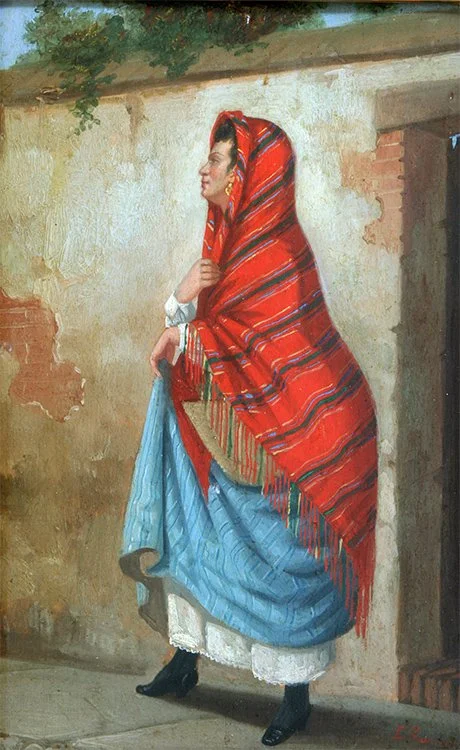
Spanish Lady, 1874. Oil on panel, 6.7 × 4.4 in. Private collection.
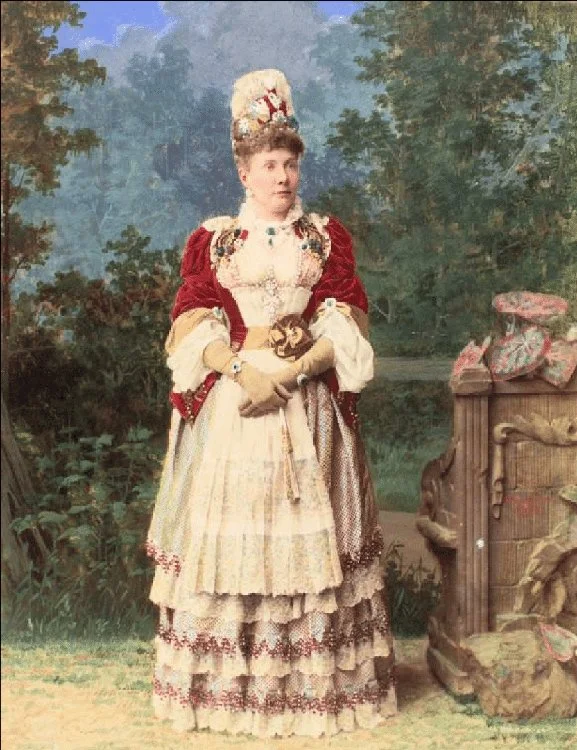
Infanta Isabel de Borbón dressed as Coralina, 1884. Hand-colored photograph. Royal Library of Spain.
Rumoroso was closely connected to the photographic arts. At least several of his paintings were circulated via photography. In two examples, Emilio Beauchy Cano photographed La Riña (The Quarrel) and Volviendo de la Feria (Returning from the Fair), preserving images of works whose present locations remain uncertain.⁽⁷⁾
Rumoroso also collaborated with royal court photographer Fernando Debas, applying color by hand to photographic prints. In 1884 he hand-colored a large album commemorating a costume ball held at the palace of the Duke and Duchess of Fernán Núñez. The album was commissioned by the duke, with a copy intended for the queen.⁽⁸⁾
Still another connection to photography can be found in Rumoroso’s painted portrait of the young King Alfonso XIII, dated 1893 (see gallery above). Now in the Museo del Prado collection and on deposit at Madrid’s Teatro Real, it presents the child king in military uniform.⁽⁹⁾ A photograph showing the king in a nearly identical pose⁽¹⁰⁾ suggests the probability that Rumoroso worked from a photographic reference.
A photograph had the advantage of sparing a young sitter from lengthy sessions while providing the painter a flat image, with a fixed viewpoint, expression, and consistency of light. These conveniences, however, can also tend to take some of the “life” out of a painting. In this case, the portrait has a certain stiffness and stillness, with somewhat generic skin tones and a static expression. Subjectively, it’s an attractive painting. Yet it lacks some of the vitality that can come from an artist needing to synthesize their many observations over time, such as changes in expression, posture, and attention. In a manner of speaking, these subtle, changing observations can breathe life into a painting, whereas working from a photograph—which freezes a single expression in a single moment of time—can make it more difficult to render the painting as feeling “alive.”
Rumoroso’s Still Life with Flowers offers a different experience for the viewer (see gallery above). The blue vase and its gold fittings anchor the composition, while overlapping flowers emerge from a dark, loosely worked background. The bouquet feels carefully arranged for the tall canvas, with passages of precise description giving way to softer, less resolved forms. Along the right edge of the peach-colored rose, a narrow band of intermediate color eases the transition from pale petals to a dark background. Seen closely, this passage appears to preserve a portion of the underpainting. From a distance, the edge contour softens as the petals turn into space, helping to give the work a sense of life and atmosphere. These attributes suggest a painter responding directly to the flowers before him, although the brushwork alone cannot establish whether he also worked from study sketches or photographs.
Throughout much of the 19th century, photography was changing how artists viewed their subjects and the world around them.⁽¹¹⁾ Rumoroso’s work allows us to consider how these changes may have influenced a single artist.
Researched and written by Blake Manning, 2026.
Notes
1. Manuel Ossorio y Bernard, “Rumoroso (D. Enrique),” in Galería biográfica de artistas españoles del siglo XIX (Madrid: Imprenta de Moreno y Rojas, 1883–1884), 605. For a dated dance scene, see Isbilya Subastas, Subasta de septiembre de 2023, lot 256, Juerga en el patio, catalogued as signed and dated 1876. Ossorio catalogue record; Isbilya catalogue, PDF p. 116.
2. “Edicto,” Diario Oficial de Avisos de Madrid, February 7, 1899, 1. The estate notice identifies Cádiz as Rumoroso’s birthplace and reports his death in Madrid on December 20, 1897, aged fifty-four, supporting an approximate birth year of 1843. Digitized issue.
3. Gerardo Pérez Calero, “La Academia Libre de Bellas Artes de Sevilla (1872–1888),” Laboratorio de Arte 11 (1998): 283, 287–297; Patrimonio Nacional, “Debas, Fernando,” Galería de las Colecciones Reales, accessed November 6, 2026. Pérez Calero documents membership, exhibitions and committee service, while qualifying the founding claim. Patrimonio Nacional explicitly identifies Rumoroso as a founding member. Pérez Calero; Patrimonio Nacional.
4. Ossorio y Bernard, “Rumoroso,” 605. The entry reports the bronze medal for Una escena de taberna and lists works exhibited in Madrid between 1881 and 1883. Catalogue record.
5. Beauchy Photo, “Enrique Rumoroso,” accessed November 6, 2026. This entry reports an award at a Paris exhibition in 1883 without naming the exhibition, work or award category. Independent confirmation remains outstanding. Archive entry.
6. Ossorio y Bernard, “Rumoroso,” 605. Catalogue record.
7. Beauchy Photo, “Enrique Rumoroso,” accessed November 6, 2026. The archive identifies Beauchy Cano’s photographs of La Riña and Volviendo de la Feria; it records the latter’s appearance in Instantáneas, December 1, 1900, under the title A la feria de Sevilla. Archive entry.
8. Patrimonio Nacional, “Debas, Fernando”; Inmaculada García Lozano, “El palacio y la colección de los Duques de Fernán Núñez en imágenes. 1839–1939,” in I Jornadas sobre Investigación en Historia de la Fotografía. 1839–1939: Un siglo de fotografía, ed. José Antonio Hernández Latas (Zaragoza: Institución Fernando el Católico, 2017), 189 and n. 11. García Lozano identifies the album of the February 25, 1884 ball, Real Biblioteca, FOT/21. For the duke’s commission and the copies, see José Antonio Vigara Zafra, “Los fastos de los III duques de Fernán Núñez: nuevas políticas de construcción de la imagen nobiliaria en el siglo XIX,” Caiana 11 (2017), concluding discussion and n. 56, quoting El Salón de la Moda, no. 33 (1885), 53. Vigara associates his illustrated album with the 1863 ball, so its precise identification differs from García Lozano’s account. Patrimonio Nacional; García Lozano, PDF p. 5; Vigara Zafra.
9. Museo Nacional del Prado, “Alfonso XIII,” Enrique Rumoroso y Valdés, ca. 1893, oil on canvas, 105 × 75 cm, inv. P008077, on deposit at the Teatro Real, Madrid. Collection record.
10. Universal History Archive / Universal Images Group, “Alfonso XIII, 1886–1941,” photograph, Getty Images, image no. 929211828, accessed November 6, 2026. The original photographer and date are unidentified. Getty credits a reproduction in The History of Our Country (1900), but that book reference has not been independently verified. The possible relationship to Rumoroso’s painting is the author’s visual interpretation. Getty record.
11. The Metropolitan Museum of Art, “Gustave Courbet,” exhibition materials, 2008, discussion of painting and photography, accessed November 6, 2026. The museum discusses the shared aesthetics of painting and photography around 1850. The application of this broader context to Rumoroso, and the comparisons between his works above, are the author’s interpretation. Exhibition text.